Sunday, February 27, 2011

New Years Day in Seoul


Trying on traditional Korean clothing.
I’m not going to recount every day of our time in Seoul chronologically as I have done with the previous entries.  Instead I intend to cover a few of the highlights.  This will leave out a lot of writing about subway stations.

Valerie and I were extremely fortunate.  On our first trip to South Korea, we were able to spend New Year, perhaps the most important day of the year, in the traditional South Korean manner: by visiting family, paying respects to the ancestors, followed by the elders, and then going out for the afternoon.  We were lucky to be able to borrow Sunny’s family for this.


On New Year ’s Day, Febuary 2nd, we woke up early (around 7 o’clock, which is early for us full time students) and after a light breakfast, took the subway out to where Sunny’s grandmother lives with her aunt, uncle, and cousins.   The train ride took an hour and I was the one who ended up staying awake the whole time.  The trains were surprisingly empty at this time.  It was explained to me that Seoul empties out during the New Year because everyone is returning to their hometowns to visit their families. 

On the way to the train station.
We arrived at a station between Incheon and Seoul, and got off the train.  We crossed the tracks, and then a river, and finally arrived at an apartment complex.  Many elderly people live in the complex so there was a step in the elevator so those who live on the top floors can reach the buttons. 

When we got to the apartment we were welcomed and introduced to various family members who had gathered.  Sunny’s grandmother also spoke some Japanese.  What she spoke was very basic but entirely correct.  As a child, it is probable that her elementary schooling was taught entirely in Japanese, as Korean language was reduced to an elective by the Imperial authorities and the colonial administration.

Sunny’s eldest uncle used all his best English on us, and we were able to understand pretty well.  (Most of the young people present probably spoke English as well, but may have been too embarrassed to use it.)
During this time the altar was prepared.  The altar consisted of a decorative paneled screen behind a low table.  On the table was piled a huge amount of food.  Closest to the viewer were stacks of fruit.  The next row contained some rice dishes, as well as the typical (in Korea) fried New Year’s foods.  One layer further was the fish.  Several types of fish were used, some normal and one rather pricey one which is special for marking The New Year.  Last, and perhaps most important, were three bowls of rice; one for each family member who had passed away.  In each of these bowls a metal spoon was placed upright.  On the other dishes, metal chopsticks were laid across the top of the dish or placed upright in the food.  (Therefore, it is worth noting that in most East Asian countries it is extremely 失礼, that is, impolite to stand chopsticks or other utensils upright in the dish.) 

After all was in place the family gathered together everybody arranged themselves in rows in front of the altar.  We had been coached before, so were prepared when it came time to bow before the altar.  The bow is done by placing the left hand over the right hand, kneeling, and then pressing one’s forehead to your hands which should now be planted flat on the floor in front of you.  The bow lasts three seconds.  The whole process is then repeated.  Luckily, due to the hierarchy, Valerie and I were in the back along with Sunny who is the youngest in the family, so we didn’t have to worry too much about other people noticing any mistakes that I was making.

After respect was paid to the ancestors, it was time to pay respect to the living.  Sunny’s grandmother, father, and two uncles then arranged themselves and we all turned to face them.  We all reorganized ourselves and performed the bow again.  Then everybody got money!

Or toshidama, in Japanese.  (I have no idea what it is in Korean or English.)  Money is given to the younger members of the family in envelopes on New Years.  In China my impression is that red envelopes are the norm, but those we received were yellow or had polka dots.  I had been warned, but was still somewhat surprised to actually receive a rather large sum of money in total from people who I had only just met, the family of my friend. 

Now that the most important ceremonial aspects of the day were over, it was time for what I personally consider a highlight of every day: Lunch.  The food that had been placed on the altar was brought to the kitchen, added to the larger pot from whence it came, and placed on the four or so low table which had been laid out across the room.   

Sunny’s grandmother also insisted, at one point, on feeding Valerie and I by hand.  In this she was more focused on Valerie than on me, but it was still an interesting experience.  It is something that was entirely foreign and although I was told it was somewhat normal, it’s difficult to for me to understand exactly what was going on.  As sweet as it was, I’ll just be content that I avoided most of that attention.

(On a side note, today I received a Skype call from Sunny and her family who were celebrating her grandmother's birthday.  Apparently I came up as a topic of conversation and she wanted to see me again.)

Thank you Mr Sejong.
After another hour or the three of us left and took the train back to the city.  We headed for Insa-dong, Seoul’s historical main street.  This street is close to most of the government buildings and the US Embassy, which was really ugly.  As one approaches the main palace, there are several large monuments in the center of the street.  One is a tribute to the man who is credited with stopping one of the Japanese invasions and was decorated with some lovely pictures of samurai getting owned.  Further along the street is a large monument on top of an underground museum all dedicated to King Sejong the Great.  King Sejong is perhaps best known for creating Hangul, the amazing Korean script.  It takes an incredibly complex language and assigns it a script that took a dunce like me about an hour to learn how to read.  Even a month later I can still sound out most written Korean, even if I have no clue what it means. 

Go America!

This guy apparently took out a lot of Japanese.

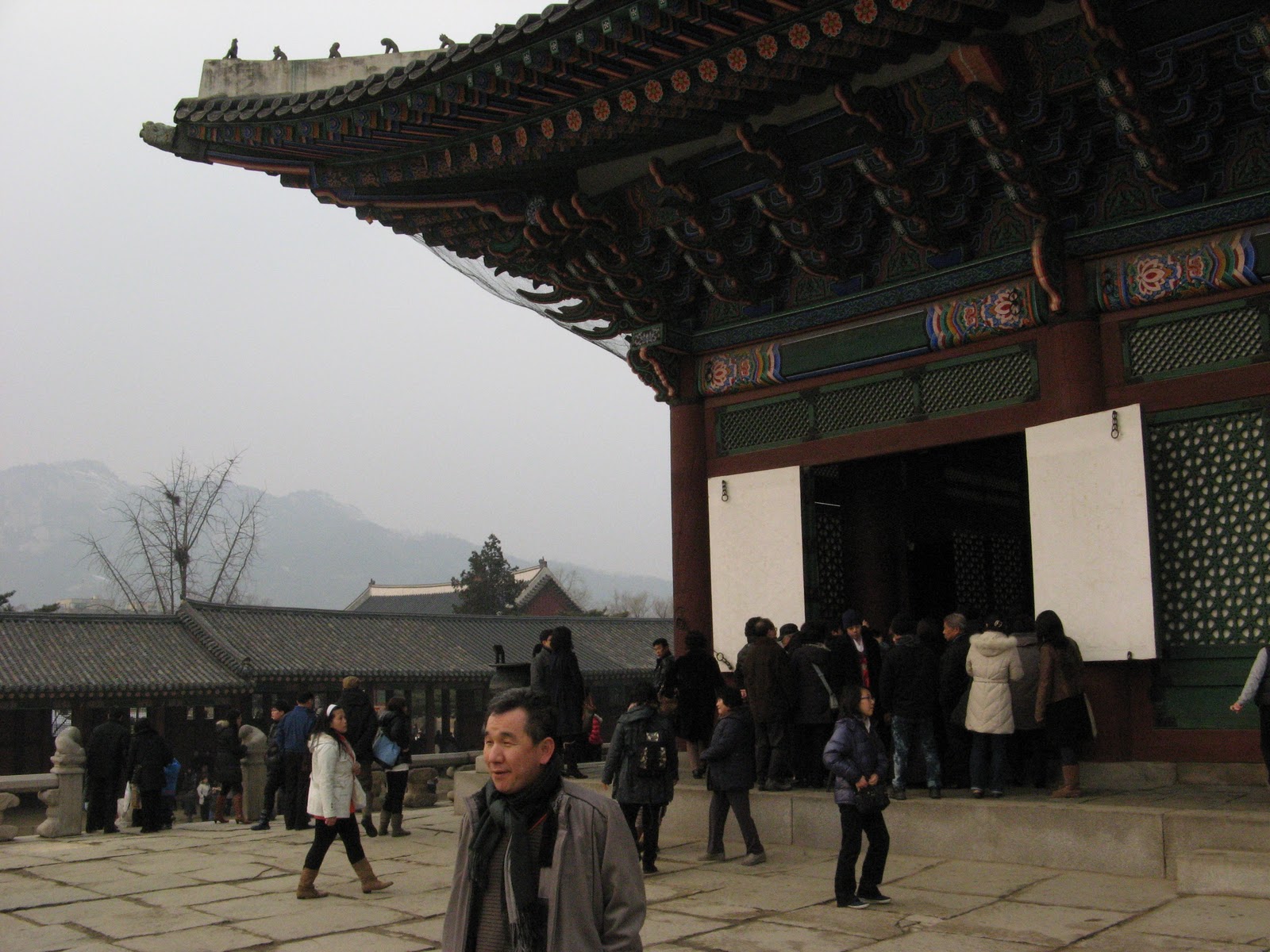
At the end of the street is the former imperial palace.  As it was New Years Day, the admission fee had been waved and it was quite crowded.  The palace is sprawling and quite beautiful.  They had also opened up some of the buildings so we were able to go inside and warm up.  The Korean National Folk Museum is also located on the palace grounds, so we were able to see a free performance by traditional entertainers outside the main gates.


何で皆ふうふみたいって言った?


That's one brave kid.
After this we headed for the neighborhood around the palace, which is apparently famous for boutique stores and coffee shops.  If I ever live in Seoul, this is where I want to live.  We had warm drinks and cake inside a three story Nescafe café.  After this we wandered through another touristy street that reminded me a bit of Kyoto, before heading back to Sunny’s apartment.


When I'm super rich living in South Korea, I'll live in this neighborhood.


It's a party, as usual.

Thursday, February 10, 2011

South Korea - Part 2

Click here for Part 1.


Again, thanks to Valerie and Sunny for the use of their photos.


The next day (Sunday) we had planned to do some traveling.  Valerie and I were quite unprepared and had very little idea of where to go or what to do, so Sunny (with the help of her mother, I suspect) planned a short trip and made reservations in some interesting accommodation.

Near the East Seoul Bus terminal.

Our first destination was Andong. We traveled from Seoul to Andong by bus.  This also offered us a chance to see more of South Korea from ground level.  It was cold.
Looking across the Han River to the south.


It cost a little more than ten dollars for the bus ride, which was extremely comfortable.  There were three seats in each row, the all reclined, had a leg rest, and provided plenty of leg room. 


I even managed to sleep, which is quite rare. 
Obviously rare enough to warrant a picture.

Andong Bus terminal.

We saw very little of the town itself, beyond the bus terminal.  Instead we took off for a smaller village built in a very traditional Korean style which is listed as a world heritage site and was located nearby.  We waited some time for a bus in the cold, but then an enterprising taxi driver asked the three of us and another pair who were heading to the same place if we wanted to share a taxi.  So we fit 5 passengers into a compact Korean taxi and took off at about 140km/hr down the highway. 
Safety first.

Twenty minutes later, we barreled around the pay parking booth and were deposited in front of the tourist office at Hahoe, the traditional Korean village mentioned previously.  It was cold.  There was an irrigation pond next to the village which we walked across.


  The wind blew down the valley over an icy river, which is probably what made it so uncomfortable.  The houses were very interesting, and the church especially was quite beautiful I thought. 


However, one of my favorite parts of the area was a small exhibit dedicated to the visit of the Queen of England to the area several years prior.  There were many large photographs from the visit, along with artifacts and helpful explanations of their significance in both English and Korean. 


We had dinner in a restaurant that caters to the normal crowds of tourists that probably infest the area when the weather is much nicer.  Noodles, chicken, and vegetables were mixed together in a sauce of some sort which was slightly sweet if I remember correctly.  It was of course served with rice and kimchi.

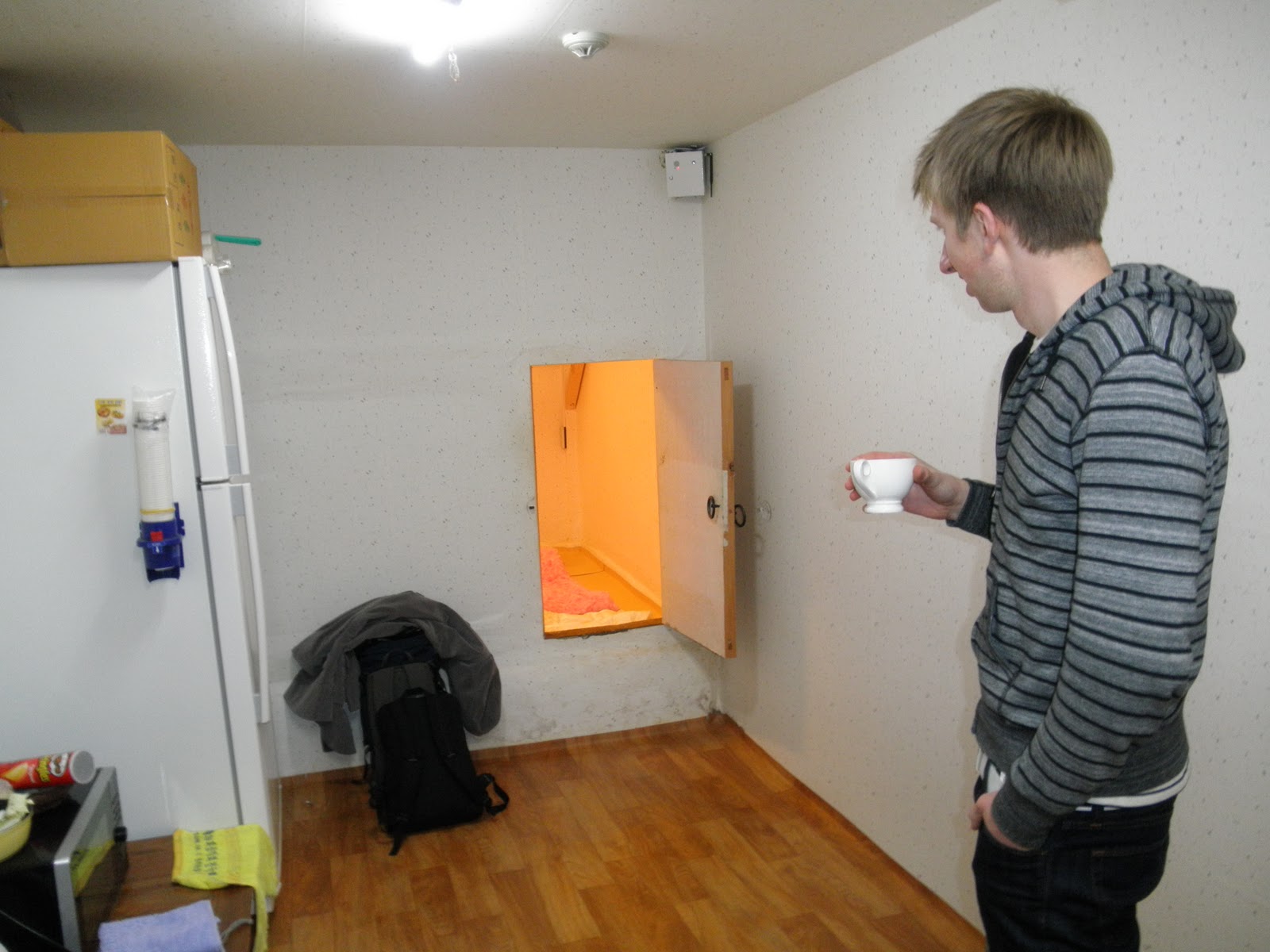
The original in floor heat system.
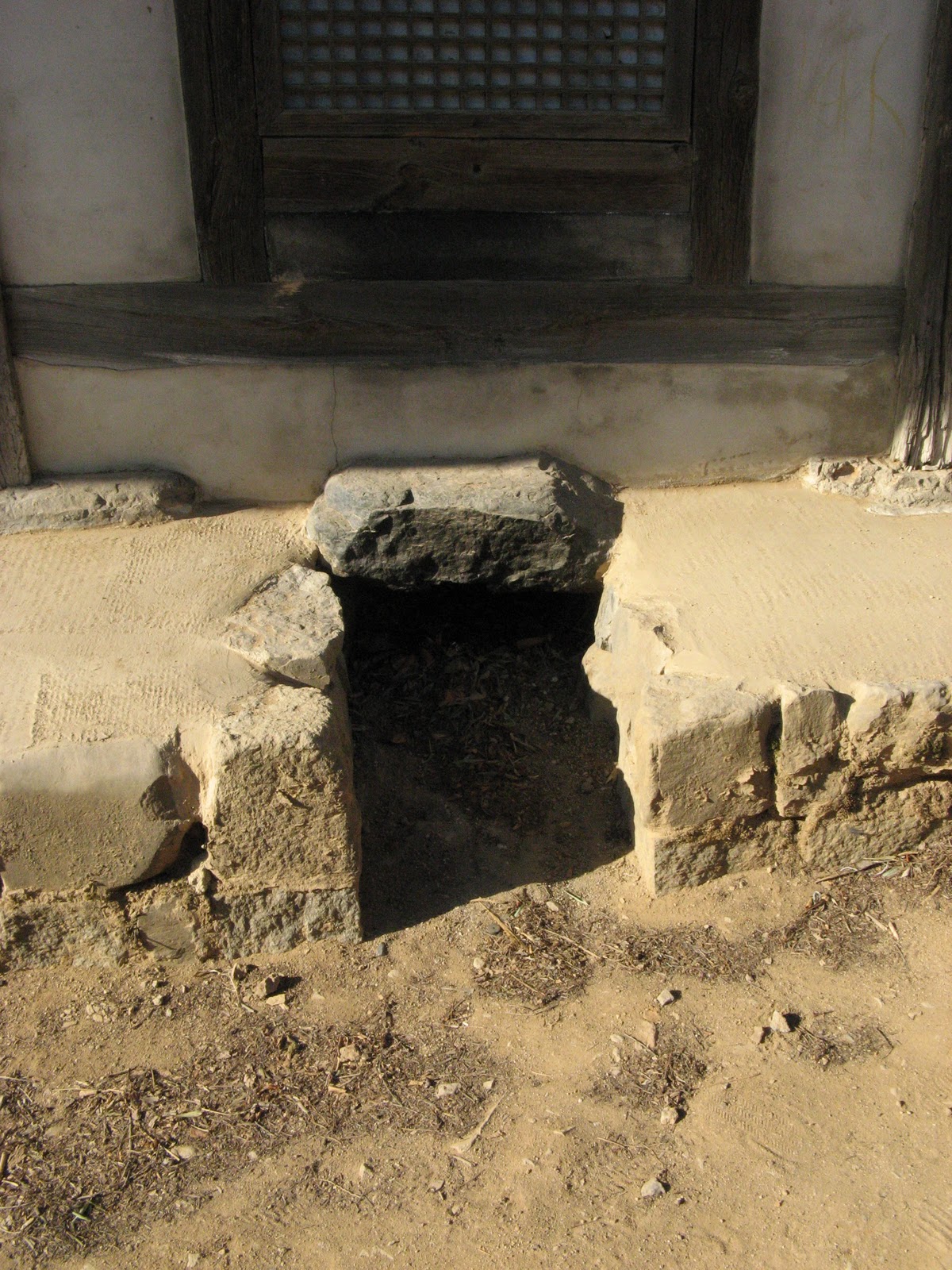
Sunny called the owner of our lodgings for the night and after we had finished he came to pick us up from the restaurant.  He drove us about 20 minutes over dirt roads until we pulled up in front of a traditional style Korean house.  We had two rooms: a kitchen/dining type of room and a sleeping room.  The sleeping room had no windows, but had two small doorways on each side of the room.  The floor was electrically heated, but 30 years ago it probably would have been heated by lighting a fire underneath the house.
Big doorways too.

Exterior door.
In the morning we awoke to find another cold but beautiful day.  We also discovered that we were in a very rural area and that our rooms were perched on a slight hill looking over the river and another series of hills on the other side.


  We took some time to explore the neighboring buildings, which are part of the normal tourist attractions and include an old Confucian school. 

We wandered along the river as well.  In the summer it must be an extremely popular place to relax, but while we were there it was iced over along the banks.  While we were at the river the owner of the rooms came down to see if we wanted to have breakfast, and we ate at a restaurant he and his wife own nearby.


Everyone's favorite president also visited here.
We managed to catch the bus back to Andong that morning.  As it bounced down the dirt road it became apparent that the road we came through at night ran along a cliff for a good portion of the ride.  As we traveled towards the town, we often stopped to pick up older women who live out in the country.  They all seemed to know each other and chatted loudly as we traveled back to Andong. 


When we got to Andong some of them started to get off the bus.  One of them accidently pressed the “Stop Request” button one stop too early, and when the driver stopped and opened the door, nobody got off.  The driver was not pleased.  According to the brief explanation provided by Sunny, he shouted that you shouldn’t press the stop button if you don’t want to get off.  As it was one of their group who had pressed it too early, most of the old women were quick to come to her defense and shouted back at him that it wasn’t a problem.  This began a shouting match between the driver and the older women on the bus.  This is further proof of the huge differences between Japan and Korea.  In Japan, when someone pulls a wrong stop they apologize and say they pulled the wrong stop.  The driver nods and continues.  Korea is certainly more interesting in this way.

When we arrived back in Andong we found that we had about two hours to wait for the next bus to Gyeongju.  We wandered around the bus station for a few minutes looking for a place to sit, and found a place inside a Maxwell House branded café.  It was at this point that Sunny taught Valerie and I to read Hangeul. 

Hangeul is an alphabet designed to fit with the Korean language as it already existed.  It is quite quick to learn and after only about an hour of actual teaching and practicing, I am still able to sound out most words a week later. 

As three o’clock approached we made a quick stop at the convenience store for some snacks before we boarded the bus for Andong.  The trip took almost three hours and it was starting to get dark as we arrived in Gyeongju.  We still had about 45 minutes to an hour of daylight left so we started out for the tourist information center to get our bearings.  On the way out of the station (a place where we were stared at an inordinate amount compared to the rest of Korea) I heard someone calling out in Russian, but ignored it and continued.

When we got outside a Korean looking man was following us.  He came up to the three of us and began speaking Russian.  As far as I understood he claimed to be from Ukraine, and he certainly seemed to speak quite fluently to my untrained ear.  However, he kept looking to Sunny as he was speaking.  I told him in the only Russian I remember that I don’t speak Russian.  He then kept asking where I was from and if I was Russian, so I told him I wasn’t.  He returned to the bus station and we continued to the tourist information center.


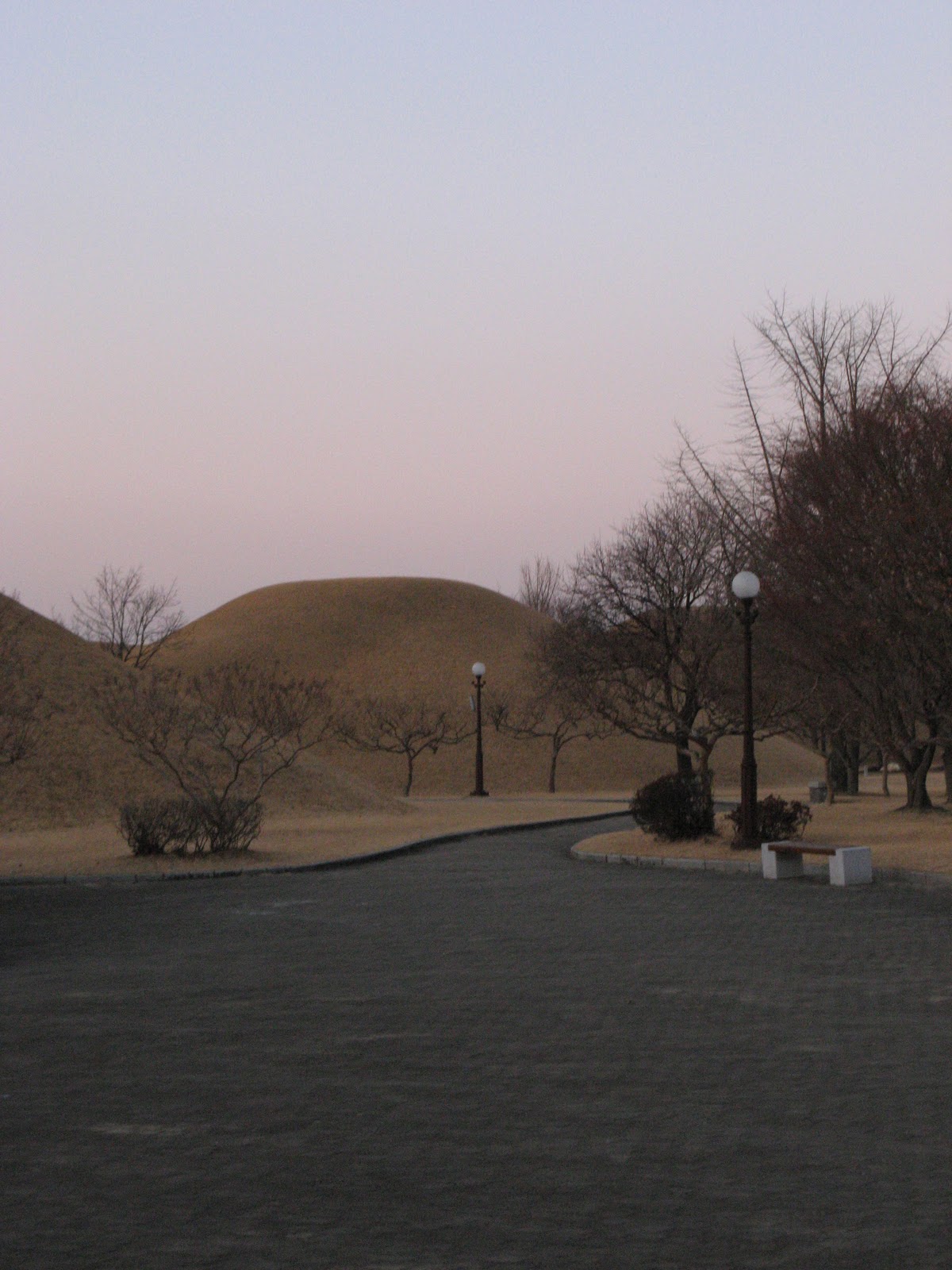
After picking up our free English language maps of the Gyeongju area, we headed for a large park quite close to the station.  It housed a large number of ancient burial mounds (kofun, in Japanese.)  They contained the graves of royalty of a kingdom which was based in the south of Korea almost 1000 years prior.  One of the mounds had been hollowed out and we were able to go inside to see the different layers, as well as some of the artifacts found inside the mound.

Trying to hide from the wind.  Why didn't I think to bring under-armor?!
We continued our walk and passed through a large park with an ancient observatory and beautifully lit trees.  It was really cold.  We visited the site of the palace of the same kings who were buried in the kofuns.  Some parts have been reconstructed and are lit up at night.  Most of the tourist brochures for Gyeongju show it lit up at night, however when we went the pond was ice. I didn't take any pictures here because it involved moving my hands.

We got on a bus to head for the hotel, but due to some mix up the bus did not go exactly where we needed to, so Sunny called the number to try and clarify the location. She got some directions, but then another woman on the bus offered to help, took her phone, and managed to arrange for us to get picked up from the next bus stop.  We got off the bus and huddled in the shelter for about 5-10 minutes before a sliver Mercedes pulled up to the bus stop.  A middle aged woman motioned for us to get in. Sunny went to talk to her and it was our pickup from the hotel.  Valerie and I squeezed into the back along with the woman’s shopping and Sunny took the front passenger seat.

We quickly arrived at our accommodations.  It was not a hotel or hostel as I was expecting, but instead a small apartment on the third floor of a building housing a restaurant.  We arranged to have dinner in the restaurant and set our bags upstairs.

When we came back downstairs we sat on another heated floor around a low table.  We were served the Gyeongju specialty (which it seemed like every restaurant on that street served).  The tofu was cooked in a slightly spicy soup with a little bit of seafood and brought to the table in a stone bowl.  About 9 different types of kimchi and other preserved foods were laid out as well, along with the normal bowl of rice.


After dinner we went upstairs to our rooms to drink tea and watch TV.  There was cable so we watched the news and a somewhat horrendous learn to speak Korean program on Arirang tv, a channel for English speakers.  After that it was a special about the K-pop group Girls Generation, and on another channel a movie about a group of people on a cruise ship being attacked by thieves and a giant monster.

In the morning we packed our bags and started off for Bulguksa temple.  It was starting to warm up so the weather was not as unbearable as before.  The temple was quite large and is probably the most famous attraction in the area according to Sunny. 

After viewing the temple we continued up a trail towards the Seokguram Grotto.  This grotto contains a very large statue of the Buddha.  

It is built into the side of the mountain, and although you must view it from behind a large window, it is probably one of the most impressive pieces of art I have seen since in any temple area.  From the window, the viewer looks down a small hall with pillars hewn out of the rock.  A quick google search brings up some professional images of the cave.   Like most important Korean sites, parts of it were dismantled and moved to Japan during the colonial times pre-1945. 
View from the front entrance to the cave.
It is also common to leave messages of good will and such on the roof tiles which will be used when the roof of various buildings around the temple will be redone.  The variety demonstrates the popularity of the site.

We walked back to the parking lot, and waited for a while before we caught a bus back towards the city.  We eventually made it to the bus station, and bought tickets for the bus back to the East Seoul terminal.  As it was the day before the New Year’s Holiday, the bus was full and traffic heavy.

A Links to my Facebook photo albums: Album 1     Album 2

Next time: Seoul

Monday, February 7, 2011

South Korea - Part 1

Although it’s only a two hour flight away, South Korea sometimes seems like it’s a world away from Japan.  Having spent a week in South Korea, I’m repeatedly mentally kicking myself for not having started Korean instead of Japanese, despite the fact that it’s a much more difficult language and despite the fact that learning it would probably be quite difficult, due to the high levels of English among university students and graduates in Korea.  But, I do realize that if I spent more than a week there and developed a normal routine which did not resemble that of a tourist I would probably have a very different opinion. 

For scheduling purposes it was decided sometime on the 25th or 26th of January that it would be most convenient for Valerie and I to visit Sunny at her home in Seoul during the current vacation, instead of in March as originally planned.  We were lucky to find and, despite the best efforts of the airline, purchase tickets for Saturday the 31st of January.

Flying on a discount airline provides an interesting comparison to your typical Delta or United international flight.  For one thing, Jeju airlines (named after a popular Korean resort island) operates a website which only provides a translated web page for routes that touch countries with that official language.  For example, the English page only provides information on the routes between Hong Kong and South Korea.  The Japanese page, correspondingly, only provides information on routes which touch Japan.
Secondly, on Jeju Airlines, everybody flies in Joy Class.  I would also like to note that in Joy class all the arm rests have ashtrays built in, which attests to the age of the aircraft.  I was nervous that if one peeled back the labels on the seatbacks which note the location of the life vests in Korean and English, the label below would be printed in Cyrillic. 

After the in-flight refreshment, which consisted of a beef Onigiri and your choice of orange juice, water, or coffee, I studied Kanji using a slick Nintendo DS game I bought a few weeks ago with the assumption that I would be bored out of my mind this vacation, so I might as well learn something.  Valerie slept.  Soon we were able to see Korea.
What sort of idiot goes to Korea in January when most people are heading for Thailand?

It looked cold.  Even the largest rivers appeared to be frozen entirely.

Upon arrival we made our way through a nearly empty international terminal at Incheon International Airport, about an hour outside of Seoul proper.  We received a warm welcome from Pierce Brosnan, who recommended the Paradise Casino.
Thanks.

An amazing thing about going through immigration control in Incheon was the English ability of the interviewing officer.  We both marked that we were visiting friends on our customs form (which interestingly was an option next to the usual business, travel, study, etc.) but had neglected to get an address or write down Sunny’s phone number.  He let us in anyway, but I commend him on his ability to thoroughly probe the depths of our unpreparedness in clearly understandable English.

Thankfully Sunny was waiting beyond customs.  Together we picked up our bags and proceeded to the train.  Another thing I liked about South Korea was the cost of public transit.  When we traveled to the airport in Japan it came to around $20 USD.  In Korea it cost approximately half that and took about the same amount of time. 
Reunited!

We disembarked at the station and walked for about 5-10 minutes to the condo where Sunny lives with her family.  On the way I noticed that, yes, Korea is much dirtier than Japan.  However, I have to admit that I found it refreshing after the ugly but very clean atmosphere of Japanese cities. 

The condo was on the 16th floor of a new building.  It had three bedrooms, two bathrooms, and a large kitchen and dining area.  I’ve since been informed that this is definitely a large apartment by Korean standards.  Another amazing thing about the condo was the heat.  Japanese homes in the region where Valerie and I live have no central heating and no insulation, so although it rarely drops below zero (and when it does, it’s a huge deal) I am constantly cold in the house and spent the first part of the vacation in bed with my Kindle or DS, as that was the best way to stay warm if I was going to stay home.  This home had in floor heating and I was too warm in the house on occasion.
The view from Sunny's room.

That evening the three of us when out to dinner in a local restaurant. (I should point out now that this restaurant is not typical for Korea.)   It was an experience that I think would frighten many of my acquaintances in Japan, but I think part of the reason I liked it so much was because it was an experience which be entirely alien to some.  The restaurant was crowded, but Sunny went ahead and asked for a table.  She came back and we followed her into  the restaurant.  The interior was somewhat dark and covered with sticky notes with messages in Korean, Shochu girl posters, and some handmade decorations, which included one featuring the chief waiter of the establishment on a wanted poster next to Osama Bin Laden and one “Mr. Kim” of a city about 200km to the north.

After becoming used to Japan it was a relief not to have anybody shout “IRRASHAIMASE!” as soon as I open a door or look at the shop.  In fact, the waiter, appropriately dressed for the occasion in a jeans, a yellow t-shirt, and sunglasses, was too busy to move out of the way when I opened the door so I had to carefully slide around him without knocking over anybody’s drink.  (It was not a large shop.) 
We made our way to what was labeled the “VIP Room” in the back to wait for a table to become clear.  The VIP Room was obviously a smoking deck which they had covered in plastic and plugged in a heater due to the cold.  It hung out a little bit over the train tracks, but seemed solid enough, at least enough to accommodate the group of eight who came in after us.

When a table became available we did our best to get seated without putting our coats or gloves in somebody’s beer or kimchi.  The ordering process is very simple, you name tell the waiter how many people you have in your group, and an appropriate amount of pork is placed on the portable stove set up on your table, along with some kimchi.  In addition, you receive a dish of thinly sliced daikon (I think), some soya powder, and some sort of a red sauce.  As the meat finishes cooking in front of you (the start it on a grill somewhere in the back) you cut it into small pieces with shears provided by the restaurant.  If need more condiments, water, or napkins, you get it yourself.  If you need more meat, rice, or sake you call to the waiter.  Apparently that doesn’t always work as some patrons would just smack him or yank on his shirt as he passed, and he would shout at them, finish whatever he was doing, and then deal with them. 
危ない!


The other waiter sported aviators, spoke some English. After discussing with Sunny where we were from and how she knew us, he spoke a bit with me, and then tried out a little bit of German on Valerie.

Sunny was going to meet with a few of her friends, so Valerie and I retreated to a nearby branch of the chain “Angel in Us Coffee”, which appears to somehow be associated with Vaseline.


Anyways, we sat and talked and people watched for a while before Sunny returned with a few of her friends who wanted to meet us.  We spoke with them for a bit and managed to navigate the cultural landmines without too much trouble.  Soon, another acquaintance arrived.  He was on leave before finishing his last 100 days of military service, which in South Korea consists of two years of compulsory service.  He lived in the US for two years when he was younger and now works with the American military at Camp Humphrey.  It took me a few tries to figure this out.  At first when he spoke to us, I had no clue what he was saying, I couldn’t even identify the language.  Next I thought it was Korean, and then one sentences later something clicked and I understood everything:  He was speaking American English with an incredibly strong North Carolina accent, which in some ways makes sense as Camp Humphrey is almost entirely staffed by servicemen and women based at Fort Bragg, North Carolina.

It was extremely cold outside, especially after living in a part of Japan which is usually between 5-10 in the winter, so we took a taxi back home.  In most other countries I would have toughed it out and walked the whole 20 minutes or whatever it would take, but we took the taxi and it cost roughly $5USD.  (Another friend told me that to get to a certain building on her campus in Seoul, she and a friend will share a taxi instead of walking to the this building as it is cold in the winter, on a hill, and costs less than cheap cup of coffee.)

Part 2 will be up soon and will cover our trip to Andong and Gyeongju.

Not all the photos are mine, so credit to Valerie and Sun Hyun.

Wednesday, January 19, 2011

Trip to Kurashiki, Takamatsu, and Naruto

After so many weeks of silence, here's another entry. 

 The main reason I have been silent for the last few weeks is because I traveled to Washington for the holidays, which was a nice break from Japan and Japanese hospitality and gave me chance to see the majority of people who read this blog.  As soon as I returned I had a round of short papers and final exams, which interestingly were all given in class, instead of during the normal final exam period which Japanese students are allowed.  It makes it a lot harder to take them seriously when we have to turn in the homework from the night before on the concepts we learned the day before, immediately prior to taking the final exam for the course.  Sometimes I’m shocked that UBC awards credit for any of this.

After that fun week was over, went out for all night karaoke, had a slightly busier weekend than I expected, but was able to meet some of my host sisters friends.  It was a refreshing change of pace from being with either senior citizens or university students all the time, and a relief to be able to confirm that not all Japanese families are hoarders.
  
(All links for photos and videos are posted at the bottom because I'm too lazy to fight with Blogger and get them put mixed in with the text.) 

On Monday morning I left with Sunny and Isaac, two friends from school who represent South Korea and Australia/Hong Kong respectively, to travel around the region a little bit.  We started by meeting on the platform in Osaka to head for the city of Kurashiki in Okayama Prefecture.  Due to heavy snow basically everywhere outside the Seto region, many of the long distance trains were running late, so we got on a late train which arrived in the station at the time we intended to leave on the other train. 

One thing about riding a late train in Japan is that they constantly apologize for being late.  Thus we had tuned out the announcements by the time we arrived in a small city somewhere between Kobe and Himeji and were told by another passenger who took pity on us that this was the last stop.

So we waited around in the cold for a long time for another train which would take to our original transfer point.  It was also late, thanks to the weather in other parts of Japan.  We finally got on that train and arrived in Himeji.  We asked a conductor which was the next train for Okayama and he told it was the next one.  He didn’t mention that to avoid going down an extremely slow rural line we would need to change a few stations ahead, but expectations of my Japanese ability are usually quite low, so he may not have wanted to confuse me.  In the future asking more questions and more specific questions would probably be better.

We didn’t figure out that we were heading off the main routes until it was too late and Sunny took the initiative and asked some nice older women who were in the same car as us.  When we arrived at the station we asked the conductor for the local line before we got on.  He explained that we would need to transfer at Okayama for our destination.  Several stops later, at a long stop in Hinase he gave us a little piece of paper where he had written out exactly which trains we needed to take, what times, and what lines they were on.  By that point, we were okay and the remaining leg was quite simple, but it made our lives less stressful and was extremely nice of him. 

It was strange for me to transfer in Okayama and somewhat nostalgic.  I had been through that station so many times before but had forgotten what it looked like until just before we arrived.  We successfully transferred and made our way to Kurashiki, which was cold.

We checked into our hotel and ate lunch at a little restaurant which was empty.  Most likely it was empty because on Monday everything is closed in a tourist town.  I was worried that we wouldn’t have enough to do with all the museums being closed, but luckily the shops were open and the historic district was large enough to keep us occupied until it got dark.  Interestingly, there was a Turkish man who had an extremely nice store in one of the old Tokugawa era merchant buildings. He spoke English so we talked for a few moments and he worked on selling me some phone charms in a manner which probably would frighten many of your typical Japanese consumers.  Just very direct and what you would expect of someone trying to make a sale in most countries.

That evening we had the local specialty of bukkake udon for dinner, followed by some yakitori at another shop.  Then we watched Japanese television, which on that night had a video clip show, which is essentially watching a bunch of YouTube clips with commentary from Japanese comedians.  (These clips so often come from the US and so often are crazy car chases, stupid motorsports stunts, and bank robberies.  No wonder many Asians are terrified of the US.  Luckily, that night there was also a bank robbery involving a pitchfork in Australia.)  This was followed by a competition between a man who owns a magnet company and made an extremely powerful magnet, and a man who owns a super glue company.  The glued the magnets together to see if the magnets were strong enough to break the glue, or if the glue was strong enough to make the magnets stay together.  After lots of epic music stolen from a variety of films and too many commercial breaks the glue won.

The next morning we bought some bento from a convenience store and went to the historic district and the canals to eat.  There weren’t many people around, but the ones who were there stared at us.  There was also a tour group from Europe, my guess is France.  We wandered for a while after that and took lots of pictures of the gardens inside the museum grounds, which were free.  Then we headed to the station, bought tickets to Takamatsu, and boarded the train.

We changed at Okayama for the Marine Liner, which runs directly from Okayama to Takamatsu.  Takamatsu is on another island with a pretty good sized chunk of ocean in between, so the train runs across the Seto O-hashi (literally the Seto Big Bridge).  This bridge is around 14 kilometers long, hops from island to island, and is a mixture of suspension and other types of bridge.  I took a video of the majority of the crossing, which I will post at the bottom of this page.  With great weather like we had it is probably one of the most amazing stretches of train track in the world and I would be willing to travel out there just to ride over it again.  (Which incidentally, you can do for very cheap by buying a cheap ticket, and then not leaving the JR network until you arrive back home or at the next station over from where you started.)

Takamatsu is a surprisingly attractive city, but maybe that’s just in comparison to Okayama.  The station and building around the station are quite new.  It also has an amazing bike rental system which only costs 100 for 24 hours of use.  Needless to say, we rented bikes and used them to get around the city.

After dropping our bags off and having the local Sanuki Udon for lunch, our first destination was the lighthouse in the harbor.  The travel down the long pier to the lighthouse appears to be a popular place for joggers.  (Incidentally, a park in Tokyo is having problems with too many joggers, with as many as 4000 people coming out for a run on weekday mornings between 6am and 9 am.)  We took some pictures there and then headed for Ritsurin Koen.  In the winter on a Tuesday afternoon there were probably only ten people in the whole park which made for a nice experience.  It was quite large and very well kept, as is expected in Japanese gardens.  The light wasn’t the greatest, but photos can be found in the album link at the bottom of the page.
After more udon for dinner, we went back to the lighthouse, turned in our bikes, and looked for a way to the top of the Takamatsu Symbol Building.  It is a relatively new skyscraper complex with offices and a shopping center.  The top floors housed several pricey restaurants.  Luckily, the restaurants were still open which meant the elevator was still open.  As there were several restaurants at the top they had a lobby area where we could admire the view and take some photos, all without having to pay a single yen.

With an early start, we headed for Naruto a town which is famous for its whirlpools in the narrows outside town and shares its name with a popular Ninja who wears and orange jumpsuit.  The town itself was horribly depressing, but the bridge was amazing. 

A visitor center has been built in order to collect your 500 yen and pipe either epic music or music that sounds like it’s from The Legend of Zelda: The Wind Waker depending on where you are on the bridge.  There was an extremely excited English speaking staff member who rushed up to me as soon as I walked in the door to give me a free postcard and asking where I was from, completely ignoring my friends until they quite plainly stated that they wanted some free stuff too.  It was explained that we were all foreign, and because we were together he jumped to the conclusion that we were all American and they managed to get their free postcard and origami with an explanation in English.  This demonstrates the usual attitude towards foreigners: white people are much more interesting than other types of foreigners. 

The whirlpools were kind of interesting, but much more effervescent than the promotional materials suggest.  You have to watch for the whirlpools to form, and then they usually were around for only a few seconds before disappearing.  It was, however, and fascinating experience to be able to walk all the way out under a suspension bridge and be able to feel the structure vibrate with the traffic and the wind.  It also made for an excellent place to look at all manner of ships which passed under through the narrows on their way towards the Pacific Ocean or the ports to the south of Osaka. 

Before heading back towards the bus stop, we visited the museum with information about the whirlpools and the area.  It had quite a bit of information on the construction of the bridge and bridges in general as well. 
We caught a local bus back to the high way bus stop, which was located underneath the expressway.  After buying a ticket we took a small tram up to the side of the highway, where a specific expressway bus stop had been constructed.  We managed to get the correct bus back to Sannomiya, in Kobe.  This being our last evening together as a group, we wandered Kobe for a little while and had cheap Gyu-don near Motomachi station.  Then we went to the third floor of a coffee shop and sat in the cigarette smoke for a bit to make sure we got home after our host families had finished dinner.  After a short walk to the Hankyu station, we took the express train towards Osaka. 

It was a really fun trip, but by the end I was exhausted.  Now I just have to figure out how to fill the rest of my vacation until school starts up again for a while in February. 

The photos from this trip are posted here.

And lastly, a short video of the Seto Bridge, some of Rural Shikoku, and the Naruto Whirlpools.

Sunday, December 12, 2010

Hikone, Sekigahara, and Hieizan

Last weekend I went on a field trip that lasted from Saturday morning until Sunday afternoon.  I took the train from Nishinomiya, where I live, up to a castle town called Hikone, north of Kyoto on the shore of Lake Biwa.  There we walked the old highway into the town and visited the castle.  It was amazing to have a professor with us who could point out the oldest buildings, what they were used for, and why they were situated the way that they were.  Even from 2 kilometers outside the town, all of the buildings and roads were configured to force travelers to show their weaknesses as the came closer to the actual town.

That night a group of us, along with our professor stayed in a traditional Japanese traveler's inn (called Minshuku) in the town of Sekigahara.  Sekigahara is the location of the famous battle of Sekigahara which lead to the establishment of the Tokugagwa bakufu and the Edo Period. I have a photo album from my Facebook account of the trip here.

The following Tuesday, I went with a much smaller group to Hieizan, a mountain temple complex on the north side of Kyoto.  Hieizan is the focal point of Tendai Buddhism in Japan.  We walked up the mountain from Kyoto and took a cable car down on the other side, before taking a train back into Kyoto.  Another tiring day but an interesting trip nonetheless.  You can find some photos here.

Sunday, November 21, 2010

Thursday, November 18, 2010

Japanese Language

Hola,

It's been quite a while since I've posted, I know. However, the important thing is that I beat Parker and post before he does.

As you undoubtedly know, they speak this crazy language called Japanese here in Japan. For me it's quite difficult, so I'm going to do my best to outline why I have so much trouble with it.

First off, word order and grammar are almost the exact opposite of English. In English, usually the verb comes at the beginning or in the middle of the sentence. In Japanese it usually comes almost at the very end. The idea that I wouldn't know what was going on in the sentence until the very end bothered me for quite a while when I first started studying, but I've become accustomed to it. The larger problem for someone coming from English and Spanish to Japanese is that you almost have to think backwards. For me, that is less of a problem at this point. I'm finding difficult to explain how it was so difficult, which I suppose is a good sign.

Particles are another difficult Japanese linguistic concept for non-native speakers. As was demonstrated by my teacher mixing hers up several times, it can be confusing for Japanese people as well. Particles are the short words and syllables which designate the different grammatical parts of the sentence.

For example: sensei (teacher) wa (particle) tomodachi (friend) ni (particle) kami (paper) o (particle) agemasu (gives).
Translation: The teacher is giving my friend a paper.
In Japanese: 先生は友達に紙をあげます。
The particle "wa" designates sensei as the giver. The particle "ni" designates the friend as the receiver. The particle "o" shows that paper is the object.

If you switch the particles the meaning is quite different: 先生に友達は紙をあげる。
"Sensei ni tomodachi wa kami o ageru" in (rough) romaji.
Now the meaning is "My friend gives the paper to the teacher.

A few syllables can change the meaning in practically any language, but the structure of Japanese isn't particularly natural to most native English speakers. The particles are an ever-present part of life, and some get easier. Others, however, are still quite frustrating and the supposed English language explanations can't capture the nuances of the differences between them.

Japanese is taught as a series of grammatical structures which are used depending on a variety of things, but mainly the situation and how it affects the other people around you. From my point of view this leads to a very structured language which is difficult to make flow as English and Spanish do. However, with time certain structures get faster as you use them more often. Then you can add the less familiar ones into your speech. The same may be true of any language, but I find that Japanese often seems to be made of nothing but formulaic grammatical structures combined, spliced, and grafted together to make conversation.

Another common difficulty is counting. Depending on what you are counting the numbers change. Sometimes you just add another word onto the existing numbers (or some form of them.) Other times, the number is recognizable. The number four is either "yon" or "shi". When counting days, it becomes "yo ka".

Lastly: reading and writing. Japanese is made up of 3 different writing styles which are all combined together. The three styles are katakana, hiragana, and kanji. Katakana and hiragana (hereafter referred to as "kana") are syllabaries, meaning every character corresponds to a syllable.

For example (in hiragana): か き く け こ (ka ki ku ke ko)
Now, the same in Katakana: カ キ ク ケ コ
The k sounds look similar in katakana and hiragana (luckily) but others don't look so similar. For example, ro is ろ or ロ。

Now we can add in kanji. Kanji are based on Chinese characters. Some are exactly the same as their Chinese counterparts (down to pronunciation), while others are look nothing like the Chinese equivalent. Kanji are (as many Japanese people reassure me) even difficult for Japanese. (Not at the level I'm at.) There are thousands of kanji. It is commonly said that about 3,000 are needed to read a newspaper. Practically all kanji have a meaning of some sort attached to them and are quite logical when you break them down. For example, 歩く. The first character is kanji and the second hiragana. The kanji is, in this context, pronounced as aru and has the meaning "to walk." if you look at it closely you can divide it into two parts: 止 and 少. You could roughly say it has the meaning of "small stops". Most kanji can be broken down this way and often I can understand the meaning of signs and other writing but have no idea how to pronounce it.

In writing, all three of these are combined together. An example comes from a bit of an essay which I wrote for a course recently about American and Japanese styles of comedy. It's probably at about the level of Japanese ten year old, just not as fluent.

日本のコメディーの主人公は若者です。だいたい、高校生とか大学生です。日本の「僕たちと駐在さんの700日戦争」と言う映画の主人公は高校生です。「ワォーターボーイズ」と「スワィングガールズ」も主人公は高校生です。シコふんじゃったは大学生です。アメリカのコメディーの中では高校生とか大学生の主人公がいる映画が多いけど、これはとても小さい見本です。実は、他のアメリカのコメディーの主人公は若い大人です。

Despite all this, communication isn't always as complex as it appears here and there are lots of borrowed words from English. The trick is to figure out what the original English word was before it was adopted by the Japanese, shortened, rearranged, and thrown into regular conversation.

Now I should actually go do my homework instead of describing what I need to work on.